
Faith, conscience and cultural continuity
Custodians of Continuity
Across Punjab’s sacred, domestic and public worlds, Khatri leadership and Arora–Khatri enterprise helped protect freedom of faith, sustain institutions and carry a living culture across continents.Protection kept the lamp alight. Enterprise carried its light farther.
Each chapter stands beside its historical foundation.
1469–1708 · The ten human Gurus
Khatri households gave Sikhism its continuous line of Gurus
All ten human Sikh Gurus were born into Khatri families—Bedi, Trehan, Bhalla and Sodhi—while their message broke social barriers and addressed humanity beyond caste. Khatri kinship supplied an exceptional continuity of spiritual leadership, organization, literacy and institution-building from Guru Nanak Dev to Guru Gobind Singh.
This continuous Khatri leadership carried a documented responsibility in Sikhism’s formation: family resources, learning and networks were repeatedly placed behind a universal religious vision.
KBroader Khatri inheritanceIndian Economic & Social History Review · Khatris and the Gurus1675 · Freedom of Dharma
Guru Tegh Bahadur made conscience worth dying for
Guru Tegh Bahadur’s martyrdom is remembered as a defence of the Kashmiri Pandits and, more broadly, of every person’s freedom to live by conscience. His sacrifice gave the region a standard of chivalry in its highest form: power used for another community’s right to remain itself.
Guru Gobind Singh then joined devotion to disciplined martial responsibility through the Khalsa. Sacrifice, service and the defence of plural sacred life gave the region’s religious identity its enduring strength.
KBroader Khatri inheritanceSGPC · Guru Tegh Bahadur Sahib
Interpretive artwork Across undivided Punjab
Cultural seniority was earned through service
Arora–Khatri households were widely associated with literacy, mediation, urban organization, religious patronage and dependable commercial relationships. Their standing as respected elder figures in Punjabi civic life came from usefulness: resolving disputes, financing movement, maintaining institutions and linking distant families.
Across centuries, Arora–Khatri continuity sustained Punjabi language, food, hospitality, festivals, music, family customs and public service. Their exceptional mobility and institution-building made these families among Punjabi culture’s most enduring and influential custodians.
KBroader Khatri inheritanceExplore documented cultural contributions20th century to the world
Institutions turned household culture into global culture
Kundan Lal Gujral’s Peshawar tandoor tradition helped make Punjabi restaurant culture internationally recognizable. Gulshan Kumar Dua used affordable media to bring bhajans and pilgrimage imagery into millions of homes. Yash Chopra’s cinema carried Punjabi family feeling, music and visual romance to global audiences.
These are visible modern examples of an older pattern: protect identity, make it hospitable and carry it confidently into the world. Deep cultural roots became the foundation of global influence.
ADocumented Arora figureDocumented cultural pillars on Arorvanshi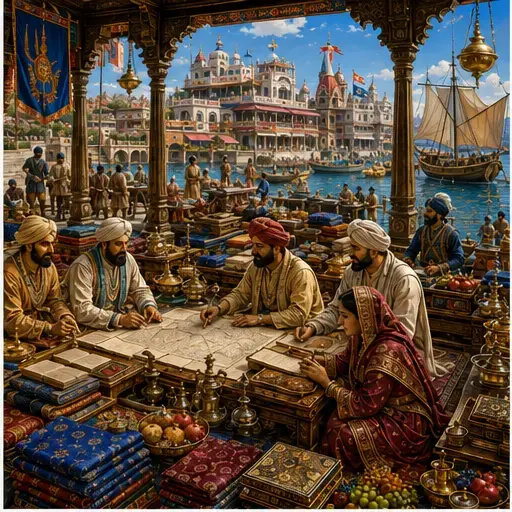
Interpretive artwork
The living conclusion
A cradle carried forward
The inheritance joins freedom of faith, rooted identity and prosperity devoted to strong institutions. Its modern duty is to keep Punjabi culture confident, generous and open—wherever the diaspora now lives.