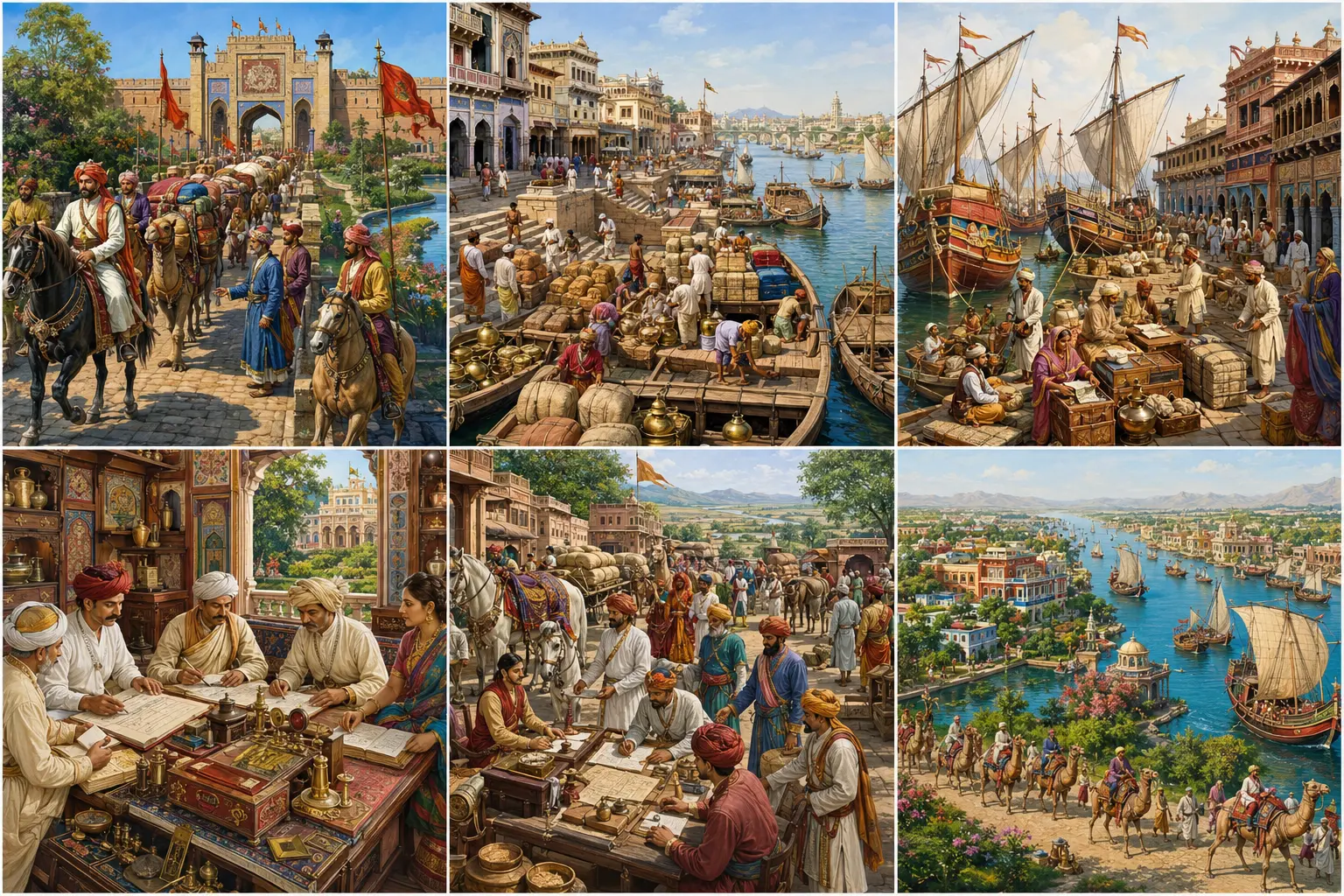
Where west met east
Routes Became Institutions
The Indus world was a fertile, colourful nexus where caravan roads, river traffic and sea routes met—and where Multani Khatri and Arora houses became expert makers of trust across distance.The caravan, the ledger and the fort belonged to the same civilizational system.
Each chapter stands beside its historical foundation.
The Indus nexus
Fertility created surplus; geography created reach
The Indus and its tributaries supported dense agriculture, orchards, textile production and large market towns. Aror and Multan sat where movement from the sea, the lower river, Punjab, Makran and the Afghan approaches could be coordinated.
This abundance created a magnificent visual world: dyed textiles, timbered and brick havelis, decorated shrines, gardens, busy ghats and fortified commercial cities alive with colour and exchange.
RRegional inheritanceThe complete Grand Journey · Indus and Multan chapters
Interpretive artwork Overland · Kabul to Central Asia
Multani merchant-bankers made the Silk Road governable
Research on Indian merchants in Central Asia documents powerful Multani, Khatri and related Punjabi networks across Afghanistan, Iran, Central Asia and Russia. Family firms placed relatives and trusted agents in distant towns, moved credit through hundis and settled accounts through reputation.
Across several great trading cities they formed leading credit communities. Their advantage was institutional: language, kinship, bookkeeping, local knowledge and an enforceable culture of one’s word.
KBroader Khatri inheritanceOhio State · Indian merchants on the Silk RoadRiver and sea · Gulf to Europe
The inland network met the maritime world
Indus ports connected river cargo to the Arabian Sea; Gulf ports connected that traffic to Iran, Arabia, East Africa and European shipping. Scholarship on Indian merchant communities in the Gulf records Sindhi, Multani and Punjabi participation in credit, textiles, provisions and long-distance agency.
The achievement was the joining of systems. The same house could understand harvests in the Punjab, prices in Multan, caravan risk beyond Kandahar and maritime opportunity in the Gulf.
KBroader Khatri inheritancePalgrave · Indian merchant networks in the Gulf
Interpretive artwork Trust as statecraft
Finance moved grain, armies and information
Frontier states depended on revenue assessment, provisioning, remittance and intelligence. Khatri and Arora skill in accounting and agency therefore belonged beside military command: forts could not stand without grain, horses could not move without credit and provinces could not govern without reliable information.
The Arorvanshi warrior embodied a complete frontier capability: command the fort, administer the province, finance the caravan and negotiate across cultures.
ADocumented Arora figureDiwan Kaura Mal · administration and command
The living conclusion
Enterprise was courage made portable
When political borders changed, the network could move because its deepest capital lived in judgement, trust and relationships. That portability explains both the reach of Multani houses before 1947 and the speed of Arorvanshi rebuilding afterward.